Education systems across Africa are under strain.
Student aspiration has expanded faster than exposure. Global opportunity has grown faster than local scaffolding. Credentials circulate widely, while readiness, judgment, and institutional capacity remain unevenly distributed.
CHIEF’s initiatives exist to respond to this gap.
They sit alongside CHIEF’s advisory work, extending engagement beyond placement into capability-building, institutional experimentation, and future-facing education models —rooted in African realities and tested against global standards.
Each initiative is developed deliberately, piloted carefully, and scaled only when it proves meaningful in practice—not just persuasive on paper.
Together, they form a portfolio of active programs and evolving experiments—many anchored in Ghana, all conceived with Africa in mind.
An Experimental School for Real-World ReadinessStatus: Pilot Initiative
Across Africa, schooling has become increasingly detached from making, building, repair, and applied problem-solving.
Young people graduate with certificates but limited exposure to:
This is not a failure of intelligence. It is a failure of design.
In many African contexts, manual skill has been culturally devalued, while formal credentials have been over-privileged—despite evidence that economic resilience depends on adaptability, technical competence, and systems thinking.
ForgeSchool™ is CHIEF’s response to this imbalance.
It is an informal, parallel learning environment that re-centers dignity in thinking and making—without positioning itself against formal schooling.
ForgeSchool explores what happens when young people are given:
The goal is not credential replacement.The goal is capability recovery.

Instruction is led by practitioners, globally trained educators, African makers, engineers, and domain experts.
Authority comes from demonstrated competence and lived experience—not academic hierarchy alone.
ForgeSchool is actively seeking collaborators across:
Write to: ideas@chiefglobal.org
Across Africa, aspiration has expanded faster than structure.
Students today are encouraged to “think global,” “aim high,” and “keep options open.” Yet very few are given the language, frameworks, or guided space to examine what those aspirations actually mean—why they exist, what they demand, and whether the path toward them is navigable.
As a result, guidance conversations often begin too late. Decisions harden before clarity forms. Confidence substitutes for preparedness. Prestige cues stand in for fit.
This is not a failure of ambition.
It is a failure of interpretive infrastructure.
Signal Interactive™ exists to address that gap.
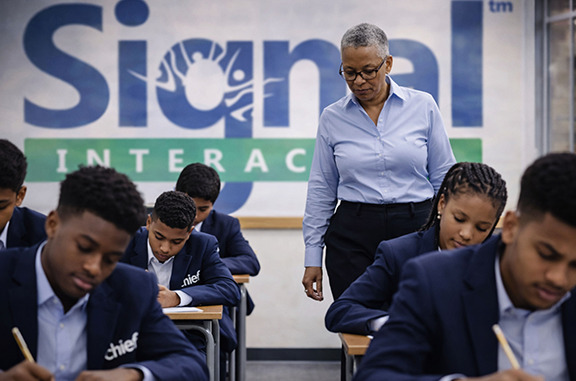
Signal Interactive™ is CHIEF’s structured framework for making aspiration legible.
It is not a test, a psychometric instrument, or a ranking tool. It does not diagnose or prescribe. Instead, it introduces disciplined reflection into systems that have historically relied on instinct, anecdote, or external validation.
Signal Interactive™ helps students articulate where they are, what they are drawn toward, and how prepared they are for the paths they imagine—without forcing premature decisions.
Signal Interactive™ guides students through a calibrated reflective process that surfaces:
The process is deliberately paced. It resists false certainty. Ambiguity is treated as information, not weakness.
The goal is not to narrow choice.
The goal is to replace vague confidence with informed intention.
Signal Interactive™ is designed to operate at multiple levels without losing coherence.
At the individual level, students gain language for their direction—even when that direction is still forming. They learn to distinguish curiosity from commitment, and ambition from readiness.
At the institutional level, anonymized aggregation allows schools to see patterns they rarely have access to: how aspiration clusters form, where exposure gaps persist, and where guidance systems consistently fall short.
The objective is not ranking students.
The objective is equipping institutions with clarity.
Over time, Signal Interactive™ also enables a broader system-level view—revealing trends in aspiration, preparedness, and misalignment across regions and cohorts. This layer is designed for reflection and planning, not surveillance.
Where exposure is uneven, clarity becomes a form of equity.
Signal Interactive™ allows African schools and families to guide earlier, with greater honesty and less panic. It ensures that aspiration is examined rather than inherited, and that guidance becomes anticipatory rather than reactive.
In contexts where opportunity is expanding but structure is uneven, this difference is decisive.
Signal Interactive™ is deployed across CHIEF’s advisory work and institutional collaborations, supporting:
It functions quietly in the background—informing judgment rather than replacing it.
Signal Interactive™ remains intentionally open in its evolution.
CHIEF actively invites educators, psychologists, counselors, and institutional leaders—particularly from African contexts—to contribute to its refinement, questioning, and expansion.
ideas@chiefglobal.orgGraduate Trajectory, Capability & National Alignment Intelligence
Africa does not lack graduate talent.
What it lacks is trajectory stewardship.
Across Ghana and the continent, master’s and doctoral aspirants pursue advanced study with limited strategic framing. Research topics are often selected in isolation from national or regional need. Global training occurs without reintegration planning. Highly trained capability disperses without coordination.
The cost is not individual failure.
The cost is collective drift.
In a world where knowledge increasingly determines economic resilience, institutional strength, and policy autonomy, this drift carries long-term consequences.
Signal Atlas™ exists to confront that reality.
Signal Atlas™ is CHIEF’s flagship African initiative for making graduate capability intelligible —without reducing individuals to data points.
It is an interpretive framework that treats graduate education not as an isolated achievement, but as a strategic national and continental asset.
Signal Atlas™ helps illuminate how advanced training, research direction, and professional specialization interact with Africa’s future needs—locally, regionally, and globally.
Signal Atlas™ is organized around questions that are rarely asked together:
What capability is this individual actually developing?
Where does that capability have leverage?
Which ecosystems—academic, industrial, public—can absorb and amplify it?
What conditions would make return, circulation, or hybrid engagement viable?
What is lost when these trajectories remain unguided?
These are not admissions questions. They are future-governance questions.
Signal Atlas™ engages graduate aspirants and early-career scholars through structured exploration of:
The framework does not prescribe outcomes. It does not compel return. It does not moralize mobility.
Instead, it makes consequences visible—allowing individuals and institutions to act with deliberation rather than default.
For universities, Signal Atlas™ clarifies graduate pipelines, strengthens alignment between research output and societal need, and supports long-term faculty and capability planning.
For governments and public institutions, it offers insight into emerging expertise pools, chronic under-investment areas, and the structural conditions that shape talent loss or return.
For individuals, it restores agency. It replaces drift with strategy. It allows global education to be pursued as leverage, not escape.
Signal Atlas™ provides the intelligence layer that makes Return with Purpose™ viable.
Circular mobility cannot be designed without understanding what skills are leaving, when they might return, and under what conditions return or contribution becomes meaningful.
Signal Atlas™ supplies that map.
Signal Atlas™ is conceived as a public-interest framework, even when piloted privately.
CHIEF invites collaboration from African universities, graduate schools, research councils, funding bodies, government ministries, and global partners committed to African capacity-building rather than extraction.
ideas@chiefglobal.orgAcross Africa, academic ambition regularly outpaces access.
Talented graduate students, early-career researchers, and faculty members aspire to engage in serious research, international collaboration, and post-doctoral training. Yet pathways to do so remain fragmented, informal, or opaque—often dependent on personal networks rather than institutional systems.
At the same time, universities abroad seek global research engagement, diversity of perspective, and access to emerging research contexts—but struggle to identify prepared, institutionally anchored partners.
The result is a persistent disconnect:
CHIEF’s Research & Faculty Exposure Programs exist to close this gap.

These programs are designed to function as structured academic exchange and research mobility pathways, connecting African graduate students, researchers, and faculty with global universities, labs, and research centers—through disciplined facilitation rather than ad hoc introductions.
They sit at the intersection of:
This is not generic “research exposure.”
It is intentional academic positioning and exchange.
For individuals:
For African universities:
For global universities:
These are not failures of intent.
They are failures of connective infrastructure.
CHIEF approaches research and faculty exposure as a facilitated academic pathway, not a one-off opportunity.
Programs are designed to support:
CHIEF’s role is to translate intent into structure—ensuring readiness, fit, and institutional alignment on both sides.
These programs are deeply integrated with CHIEF’s advisory and placement ecosystem.
They draw on:
This allows research mobility to be guided with the same discipline CHIEF applies to admissions and placement—reducing misalignment and increasing long-term value.
For Africa, research mobility is not symbolic. It is capacity-forming.
Well-structured exposure enables:
When designed well, exchange does not weaken institutions—it feeds them.
CHIEF’s Research & Faculty Exposure Programs are intentionally framed as enabling initiatives.
They are designed to:
CHIEF facilitates, aligns, and sustains—without positioning itself as the center of the collaboration.
CHIEF invites collaboration from:
These programs are evolving, and their most meaningful forms will be co-designed.
ideas@chiefglobal.orgDeveloping Circular Education Pathways
Status: Exploratory
Africa continues to experience the long-term cost of one-way educational mobility.
Talent leaves. Systems weaken. The cycle repeats.
Yet emerging policy research increasingly emphasizes brain circulation—not extraction—as the sustainable model.
Return with Purpose™ explores how global education can enable choice-based return and reintegration , through collaboration with:
The initiative seeks to design:
Return is framed as an option with dignity, not an obligation.
CHIEF invites public institutions, employers, and policy partners to co-design pilots.
Write to: ideas@chiefglobal.org